The Right Interpreter for the Right Room: Rethinking Sign Language Access in a Digital Age


Estimates suggest over 500,000 people currently use American Sign Language (ASL) making it one of the most common languages used in the US.
Yet in a hospital consultation, a federal procurement meeting or a professional conference, many still face the same barrier: no interpreter available, no accessible communication and no easy solution. Sign language accessibility has long been treated as a logistical afterthought, something to arrange when asked, rather than a standard part of how organisations communicate.
But demand is growing. Awareness of accessibility obligations is increasing and a new question is emerging for organisations of every size: how do we provide sign language access at scale, without the system buckling under the pressure?
That’s where companies like LTC Language Solutions come in. LTC Language Solutions have a strong track record of delivering language support to businesses including sign language interpretation. Paired with Signapse, you can get the best out of both human interpretation and AI-powered sign language translation technology.
Because, the answer isn’t a choice between human interpreters and technology. It’s about knowing which one belongs in which room.
Where Human Interpreters are Non-Negotiable
There are settings where the stakes are simply too high to leave anything to chance. Three in particular stand out:
Healthcare
Sign language in healthcare is one of the most critical areas of accessibility provision. In a clinical environment, an interpreter isn’t just a convenience, they are a patient safety measure. A misinterpreted symptom, a misunderstood dosage or a failure to communicate a diagnosis clearly can have life-altering consequences.
Human interpreters bring not just linguistic skill but emotional intelligence, cultural competence and the ability to adapt in real time to a patient’s distress or confusion. Healthcare accessibility for Deaf patients depends on that human presence. No algorithm can replace the sensitivity of a professional who understands both the language and weight of the moment.
Federal Procurement
Federal and public sector procurement presents an equally clear-cut case. Contractual language is precise by design. Legal and compliance obligations, including those under the Americans with Disabilities Act (ADA) and Section 504 of the Rehabilitation Act, carry real consequences when communication breaks down.
In a procurement process, errors in translation aren’t just embarrassing, they can invalidate bids, trigger legal challenges or expose organisations to significant liability. Deaf accessibility in professional settings at this level requires qualified, accountable human expertise.
Conferences and Live Events
Conferences and live events could use either human or AI-based translation depending on the context. For very technical industries, it may be more appropriate to use human interpreters as they can easily navigate specific vocabulary that AI systems may not have accounted for.
They can prepare, adapt and communicate the texture of a conversation, using humour, tension and emphasis, in ways sign language translation technology is not yet equipped to replicate.
In these settings, human interpreters are not a preference. They are a requirement.
The Gap AI Can Fill
Here’s the uncomfortable reality: there are not enough qualified ASL interpreters (or sign language interpreters in general) to meet current demand, let alone the demand of a genuinely accessible society. Interpreter shortages are well-documented, wait times are long and costs can be prohibitive.
This means that for every high-stakes appointment with a professional interpreter, there are dozens of everyday interactions where Deaf individuals simply go without.
A hospital reception desk.
A workplace team briefing.
A local government information point.
A retail environment.
Public transport announcements.
These aren’t legally complex emotionally high-stakes in the same way, but they represent the daily friction that shapes quality of life.
This is precisely where AI sign language translation technology can make a meaningful difference. Using computer vision, gesture recognition and natural language processing, AI-powered tools can provide real-time translation in environments where deploying a human interpreter would be impractical, expensive or simply not possible at short notice.
AI-powered accessibility tools are not a replacement for professional interpreters, they are a solution for the vast middle ground that currently has no solution at all.
A Hybrid Framework in Practice
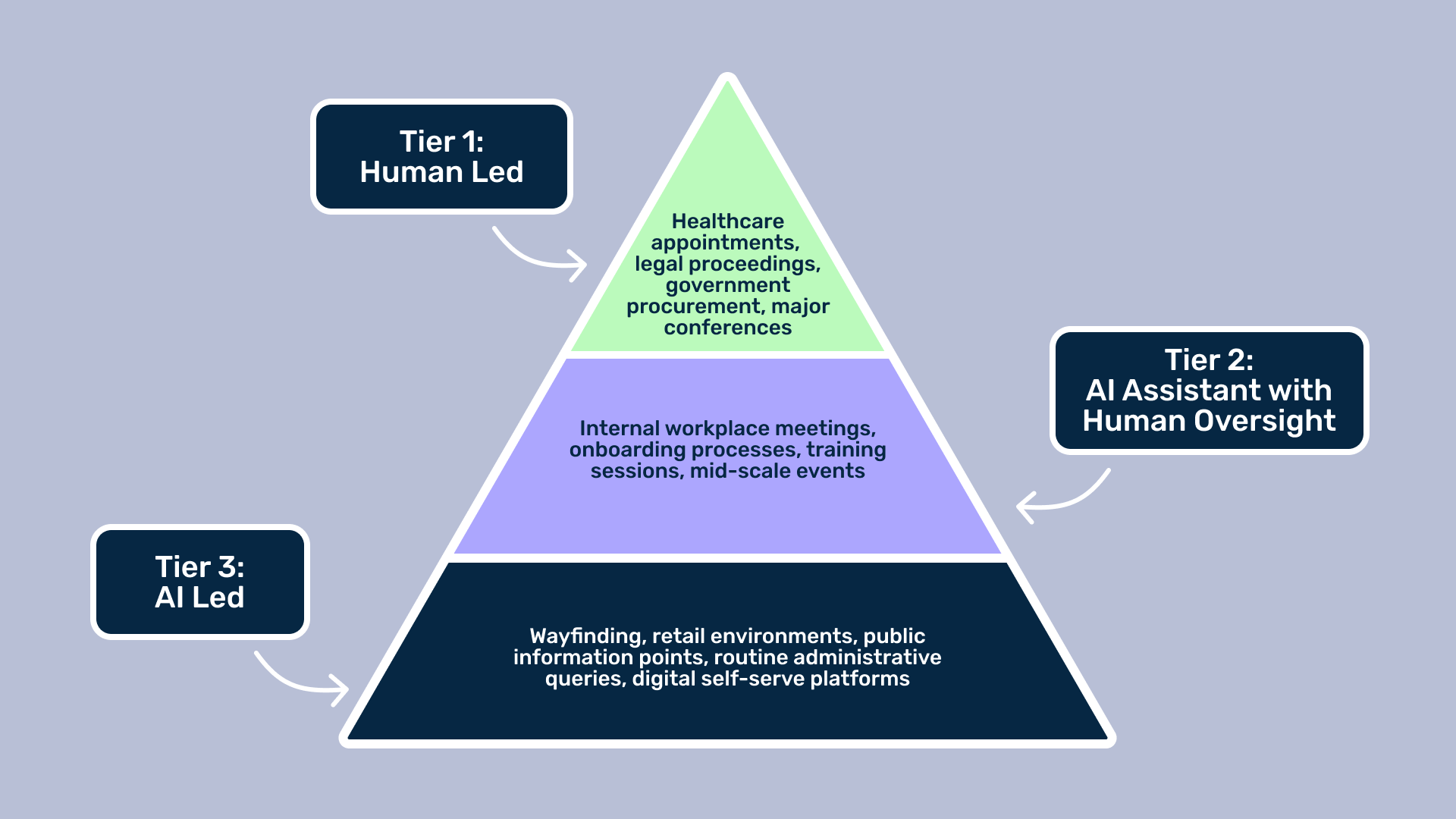
The most effective approach is a tiered model that matches the level of provision to the level of risk and complexity.
Tier 1 - Human Led
Healthcare appointments, legal proceedings, government procurement, major conferences, and any setting where accuracy, accountability and emotional sensitivity are paramount.
Professional sign language interpreters are the standard here, without exception.
Tier 2 - AI Assistant with Human Oversight
Internal workplace meetings, onboarding processes, training sessions, mid-scale events where a human interpreter is available on standby.
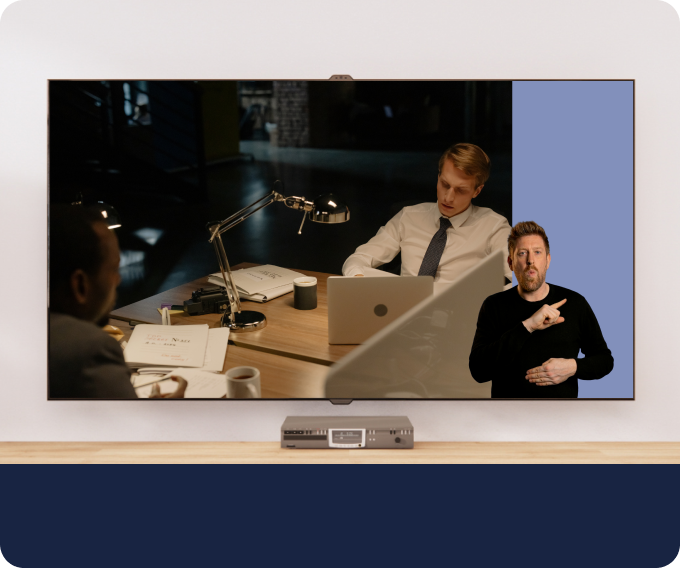
Hybrid sign language solutions (such as SignStudio) allow AI to handle routine exchanges while a professional still remains available for complex or sensitive moments.
Tier 3 - AI Led
Wayfinding, retail environments, public information points, routine administrative queries, digital self-service platforms.
Accessible communication technology handles the volume of everyday interactions that would otherwise go unsupported entirely.
This is not about replacing interpreters. It is about deploying them where they are needed most and letting technology absorb the demand they cannot, and should not have to, meet alone. The result is a scalable sign language solution that is both sustainable and genuinely inclusive.
Why This Matters for Organisations
Beyond the moral case for Deaf inclusion in public services, there is a compelling practical argument.
Legal obligations under the ADA require organisations to provide effective communication access for Deaf and hard of hearing individuals. As awareness grows and enforcement increases, the question is no longer whether organisations need an accessibility strategy but rather whether it is credible. A sustainable sign language framework demonstrates genuine commitment rather than reactive, ad hoc provision.
How Signapse and LTC are Partnering to Create a Sustainable Translation Framework
The question facing organisations today is not whether to invest in sign language access. It is how to do it intelligently.
Human interpreters bring irreplaceable expertise, empathy and precision to the settings that demand it the most. AI sign language translation brings scale, reach and availability to the vast landscape of everyday communication that currently falls through the cracks.
Signapse have partnered with LTC Language Solutions to bring this combined framework to organisations. Together, we can provide human interpreters for high-stakes settings and AI-powered translations for everyday communications offering a comprehensive and scalable translation solution for organisations.
Learn more about our partnership in our announcement or book a demo with our team to find out how your business can benefit from a hybrid translation model.
FAQs
Will AI sign language translation replace human interpreters?
No. AI is designed to complement human interpreters, not replace them. In high-stakes settings such as healthcare, legal environments and formal procurement, the expertise and accountability of a qualified professional will always be essential.
Is AI sign language technology accurate enough to be trusted?
Our current AI-powered sign language tools have been created in collaboration with native sign language users as well as human interpreters. We also run feedback groups with the Deaf community to ensure understandability is as high as possible. However, we do make mistakes which is why we always encourage feedback to ensure any fixes can be made as soon as possible. To learn more about our Signapse AI Roadmap, read the full article here.
What are an organisation’s legal obligations around sign language access?
Under the Americans with Disabilities Act (ADA), organisations are legally required to ensure effective communication with Deaf and hard of hearing individuals. Implementing a tiered sign language accessibility framework, combining both human interpreters and AI tools, demonstrates proactive and proportionate compliance.
Related Articles
The ASL Scalability Problem Enterprise Teams Can’t Ignore
What Makes an AI Sign Language Interpreter Fluent?
From Classroom to Courtroom: The Many Roles of Sign Language Interpreters
.png)
.png)