The ASL Scalability Problem Enterprise Teams Can’t Ignore

Chloe Tsang

For millions of Deaf and hard-of-hearing individuals, American Sign Language (ASL) is not just a communication tool, it’s a primary language. Yet, across industries, access to ASL interpretation remains limited, inconsistent,, and difficult to scale.
This is the ASL scalability problem: demand for accessible communication is growing rapidly but the supply of qualified interpreters and accessible content isn’t keeping pace.
Let’s explore why the ASL gap exists, what it means for enterprises, and the practical steps businesses can take to create truly inclusive content at scale.
Understanding the ASL Interpreter Shortage
The shortage of qualified ASL interpreters is well documented and it’s is a growing concern. Becoming a certified interpreter requires years of training, certification and ongoing professional development. This has led to the number of available interpreters remaining relatively small compared to demand.
At the same time, demand is increasing across nearly every sector. Healthcare providers, educational institutions, government bodies, and enterprises all require ASL interpretation services. The growth in remote work and digital content have only accelerated this need, expanding the number of environments where accessibility is expected.
This imbalance creates real constraints. Booking an interpreter often requires advance notice, costs can be high and availability may vary significantly by region. For enterprises operating at scale, this can causes a backlog in accessible content and barriers to serving wider audiences. Simply, this model cannot keep up.
Most importantly, the impact is felt by Deaf individuals themselves. Limited access to interpretation can mean missed information, reduced participation, and barriers to equal access in both professional and everyday contexts.
Why This Is an Enterprise Problem, Not Just a Social Issue
Accessibility is often framed as a social responsibility, but for enterprise teams, it is also a legal obligation.
Today’s organisations produce vast amounts of digital content, including training videos, product demos, onboarding materials, customer support resources, marketing content and more. Ensuring that this content is accessible to all users, including Deaf audiences, is both a legal commitment and a business necessity.
Ignoring accessibility creates tangible risks. These include potential legal exposure, reputational damage, and the loss of customers who expect inclusive experiences. On the other hand, companies that prioritise accessibility are increasingly seen as more trustworthy, innovative, and customer-centric.
ASL accessibility is not just about doing the right thing; it’s about staying competitive.
What is Digital Accessibility?
In the United States, digital accessibility and inclusion standards are governed by frameworks such as the Americans with Disabilities Act (ADA) and Section 508 of the Rehabilitation Act. While these regulations don’t always set out the exact technical solutions, they require organisations to provide equal access to information and services.
In practice, this means ensuring that digital content, especially video, is accessible to Deaf audiences.
Many organisations rely heavily on captions to meet this requirement. While captions are essential, they are not always sufficient. ASL is a distinct language with its own grammar and structure, and for many Deaf individuals, it is also their first language.
The pressure on digital accessibility is also increasing. Lawsuits related to inaccessible websites and content have risen steadily in recent years, signalling a shift toward stricter enforcement and higher expectations.
For enterprises, compliance is no longer a box to tick. It’s an evolving standard that requires thoughtful, user-centered solutions.
Why Captions Alone Aren’t Enough
Captions play an important role in accessibility, but they don’t fully address the needs of all Deaf users.
ASL is not a direct translation of English. It’s a rich, visual language with its own syntax and cultural context. For individuals whose primary language is ASL, reading captions can be less intuitive or more cognitively demanding than consuming information in sign language.
True inclusivity means meeting people where they are, and for many Deaf individuals, that means providing content in ASL, not just in written form.
Sign Language Translation as a Scalable Solution
To address the scalability challenges, enterprises need to look beyond real-time interpretation and toward more sustainable solutions. This is where sign language translation becomes essential.
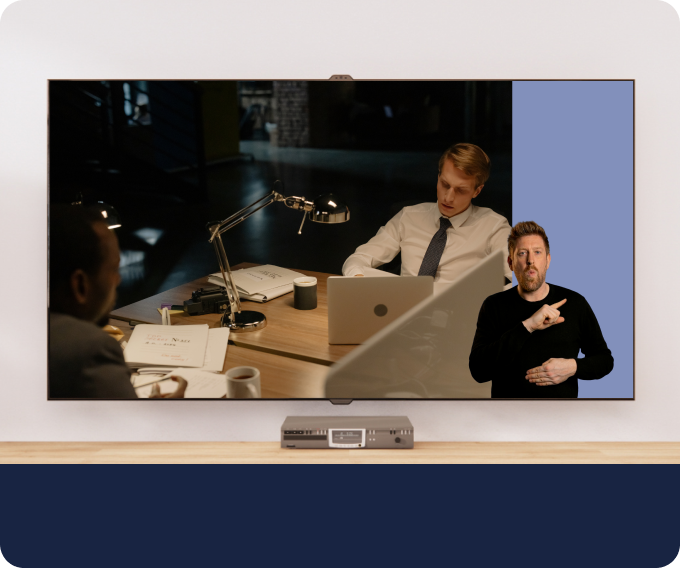
Sign language translation involves embedding ASL directly into digital content, whether through pre-recorded interpreters, video overlays, or emerging technologies such as Digital Signers.
With recent advancements in technology, these Digital Signers can be used to translate post-production content, providing businesses with a wide library of accessible content that can be accessed on demand or in live environments where Digital Signers can translate events and conferences in real time.
This approach offers several advantages. It enables organisations to scale accessibility across large content libraries, ensures consistency in messaging, and removes the logistical barriers associated with organising ASL interpreters.
Importantly, this is not about replacing interpreters. ASL interpreters remain a crucial solution in many contexts, particularly in interactive or high-stakes communication. Instead, sign language translation technology can be utilised as part of a hybrid strategy, one that combines human expertise with scalable solutions to meet diverse needs.
Practical Steps Businesses Can Take
Addressing ASL accessibility doesn’t require a complete overhaul, but it does require intentional action. Here are practical steps enterprise teams can take to get started:
1. Audit Your Content
Begin by assessing your existing content. Identify where accessibility gaps exist, particularly in video, training materials, and customer-facing resources.
2. Prioritise High-Impact Areas
Focus on content that has the greatest reach or importance first, such as onboarding materials, marketing content, and key customer journeys.
3. Add ASL Translation to Video Content
Incorporate sign language into your videos through overlay or dedicated ASL versions. Ensure the interpretation is clearly visible and easy to access.
4. Layer Accessibility Features
Combine multiple approaches, including captions, transcripts, and ASL translation. This ensures you’re meeting a wider range of needs within the Deaf community.
5. Build Accessibility Into Your Workflow
Rather than retrofitting content after the fact, translate as you go by integrating accessibility into your production process from the beginning. This reduces costs and improves consistency over time.
Prioritise Accessible Content Today
Investing in ASL accessibility delivers measurable value. It expands your audience, strengthens your brand, and demonstrates a genuine commitment to inclusion. At the same time, it helps mitigate legal risk and aligns with broader diversity, equity, and inclusion (DEI) initiatives.
The shortage of ASL interpreters is not a temporary challenge, it’s a structural issue that demands a new approach. At Signapse, we are building a scalable solution that not only honours the cultural diversity of sign language but also enables businesses to implement accessibility with ease. Our aim is to provide ASL for every screen, at scale.
By embracing AI sign language translation, organisations can bridge the accessibility gap, deliver more inclusive experiences and stay ahead of evolving expectations.
Looking to get started on creating accessible content? Book a demo of our sign language translation technology to see our Digital Signers in action!
FAQs
Is providing captions enough to meet accessibility requirements?
Captions are an important part of accessibility, but they may not fully meet the needs of Deaf individuals who use ASL as their primary language. A more inclusive approach includes sign language translation alongside captions.
For more information on why captions and subtitles are not enough, take a look at our whitepaper!
When should businesses use ASL translation?
We’d love all content to include sign language translation, but we understand that may not be possible to begin with! When deciding on what content should be translated first, businesses should start by pinpointing what content is more likely to interact with clients and customers. From your website to marketing content and live events, Signapse has a product that can translate your content!
How can companies start improving ASL accessibility quickly?
Start by auditing your content and adding ASL interpretation to your most important videos. From there, build accessibility into your content creation workflows and expand across your wider business over time.
Related Articles
Introducing Our ASL Sign Language Translator: Built to Help You Scale Your Accessibility Efforts
What is ASL?: A Comprehensive Guide to American Sign Language
How Small Businesses Can Incorporate Accessibility Tools With a Tight Budget
.png)