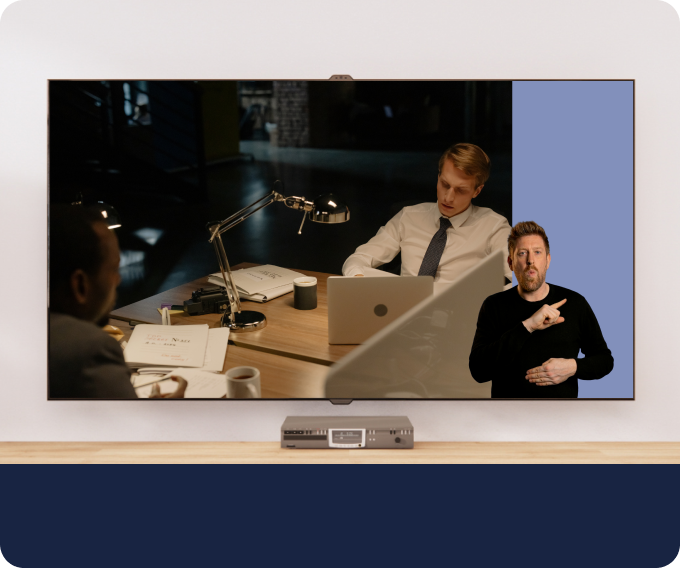
Real-Time Updates, Real-Time ASL: Why Speed Matters More Than Ever

Chloe Tsang

In a world where information travels instantly, timing is everything. Whether it’s a last-minute train cancellation, a breaking news alert, or the release of a highly anticipated streaming programme, people expect to receive updates in real time. But for many Deaf and hard-of-hearing individuals who rely on American Sign Language (ASL), that expectation isn’t always met.
Despite rapid advancements in digital communication, traditional ASL translation often lags behind. The result is a gap between when information is shared and when it becomes accessible. At its core, this isn’t just a technical challenge, it’s an accessibility issue. In fast-moving situations, delays can mean more than inconvenience, they can mean exclusion.
The Current Reality: A Process That Slows Things Down
Today, ASL translation typically involves a multi-step and largely manual process. Content is created, passed to an interpreter or translator, recorded or delivered live, and then distributed across platforms. Each of these steps introduces potential delays.
There are also practical limitations. Qualified interpreters are in high demand and not always immediately available. Coordination between teams, especially across different organisations or systems, can further slow things down. In many cases, ASL content is treated as an additional layer rather than an integrated part of communication.
This leads to a huge delay, where by the time the accessible ASL version is available, the moment has often passed. For time-sensitive content, this delay can significantly reduce its value.
Why Real-Time Matters More Than Ever
The need for real-time translation technology that converts content to sign language becomes especially clear when we look at the types of content people rely on every day.
Transport Alerts and Service Changes
Imagine arriving at a station only to find your train has been cancelled or delayed. For most people, updates come through apps, announcements, or digital boards instantly. But if sign language live translation is delayed, Deaf users may not receive that information in time to make alternative plans. This creates unnecessary stress and limits independence for Deaf travellers.
Breaking News
News doesn’t wait, and neither should accessibility. During major events, updates evolve minute by minute. However, ASL interpretation is often added after the initial broadcast, leaving Deaf audiences behind during critical moments. This delay can mean missing key developments or relying on second-hand summaries from friends and family.
Streaming and Live Content Releases
Streaming platforms have transformed how we consume content, with global releases happening simultaneously. Yet, ASL accessibility is rarely included at launch. This creates a disconnect, where Deaf audiences are excluded from shared cultural moments, whether it’s the premiere of a new series or a live event.
Across all these scenarios, one thing is clear: timeliness isn’t a luxury; it’s essential for equal access.
The Problem with Retrospective Accessibility
When ASL translation is delayed, it dampens the experience for Deaf audiences. Information is technically available, but not when it matters most.
Consider how unacceptable it would be if subtitles for a live broadcast were only released hours later. The same standard should apply to ASL. Delayed access can lead to missed opportunities, reduced confidence in information, and a sense of being left out of real-time conversations.
This isn’t just about efficiency. It’s about equity. Everyone deserves to access information at the same time, regardless of how they communicate.
A New Approach: Real-Time, Digital ASL Translation
To close this gap, a new approach is needed. One that aligns accessibility with the speed of modern communication.
By moving towards fully digital, integrated real-time sign language translators, it’s possible to significantly reduce delays. Instead of relying on a fragmented and manual workflow, translation can be embedded directly into content pipelines.
This approach can include:
- Integrating an AI sign language live translation step to your content creation process
- Implementing sign language translation into live systems such as transport networks, newsrooms and streaming platforms
- Scalable solutions that reduce dependence on manual coordination alone
The result is a shift from a multi-step process to near-instant delivery. ASL content becomes part of the original output, not an afterthought.
Importantly, this doesn’t replace human expertise. It enhances it. At Signapse, our AI technology is built in collaboration with the Deaf community. This ensures our translations are not only accurate but also reflects the culture that it is built from. The aim of our sign language translation technology is to cover low-risk content while human ASL interpreters can focus on high-risk scenarios such as legal and healthcare settings.
What This Looks Like in Practice
Imagine a commuter receiving a signed transport alert at the exact same moment as a text notification. Or a breaking news story that includes ASL interpretation from the very first update. Picture a streaming platform launching new content with built-in ASL accessibility, allowing everyone to participate in the experience simultaneously.
That’s what real-time accessibility looks like: seamless, immediate, and inclusive.
It empowers individuals to make informed decisions, stay connected, and engage fully with the world around them.
Close the Gap in Speed with Signapse
As digital transformation continues to accelerate, expectations around speed and accessibility are evolving. Organisations are increasingly recognising that accessibility cannot be treated as an optional add-on.
Real-time ASL translation represents an opportunity to set a new standard, one where inclusion is built into the foundation of communication strategies. By embracing faster, more integrated solutions, organisations can ensure they are meeting the needs of all audiences, not just some.
At Signapse, we don’t just offer sign language live translation technology, we’ve created scalable solutions that can be seamlessly integrated into your workflows. From a real-time sign language translator for live content to a streamlined platform where you can translate post-production content, accessibility is no longer out of reach, it’s right at your fingertips.
Book a demo today to see our AI sign language translation in action and experience our Digital Signers for yourself!
FAQs
Why is current ASL translation often delayed?
Traditional processes involve multiple manual steps, including coordinating interpreters, recording translations and distributing accessible content. Each of these steps can create delays, especially in time-sensitive situations. Signapse streamlines the translation process with AI sign language live translation.
Does real-time translation replace human interpreters?
Not at all! The goal is to support the work of interpreters by reducing the gap between the demand for interpreters and the current availability pool. Technology can also help make the process more efficient while maintaining the quality and accuracy of human interpretation.
Is real-time ASL translation difficult to implement?
Our solutions have been designed with you in mind. That’s why we have easy-to-use systems so you can start translating your content as soon as possible. Simply plug in our SignStream API to your platform and watch as our technology receives text and generates a video of one of our Digital Signers ready for you to share with your audience.
Related Articles
What is ASL?: A Comprehensive Guide to American Sign Language
Introducing Our ASL Sign Language Translator: Built to Help You Scale Your Accessibility Efforts
Addressing the Challenges of Sign Language Interpretation
.png)
.png)